The Problems of Decentralized Trust
TLDR: Decentralized systems sacrifice "outsourced safety" (user verification, refunds, accountability) for freedom, resulting in scams and fake reviews on marketplaces and network attacks like Sybil or Eclipse floods. While technical countermeasures exist, they are not perfect. This makes personal skepticism, pattern recognition, and intuition the best bets for making decisions.
Centralized Systems
"...existing in one place, or being the center point of a network."
"Anything that's centralized is under the control of one unified authority or located in a single place, like a centralized government."
We can consider Facebook as a good example of a well-established centralized system that has restrictions on:
- Who can sign up
- How one signs up (verified phone/email)
- How one interacts with their platform
Amazon has similar restrictions on:
- Who can sell
- How they sell
- What they sell
- To whom they sell
Although these restrictions are bad for user privacy, they exist for more than just gathering data about you.
Consider you want to buy a Children's fiction book from Amazon. You have two choices for the exact version you want:


The first book has an average rating of 2.7/5 from about 1,700 people. The second one has a 4.6/5 rating from over 1,000 people (the better choice). You can trust these numbers because there are so many reviews and Amazon takes steps to stop fake ones.
Similarly, because of how rigorously they verify their users, Facebook Marketplace ensures that the person you are meeting is real.
With Amazon, the central authority lets you ask for refunds, dispute bad sellers, or get them banned. This works because Amazon verifies your identity, making it harder for you to abuse their systems.
This is Outsourced Safety.
Decentralized Systems
"...having much of the decision-making power vested in various groups, divisions, individuals instead of in a single center of power."
Decentralized systems usually:
- Have no central authority that controls who can join the system
- Let anyone sign up without having to verify
- Take no accountability over what's shown or posted on it
These 'features' of decentralized systems bring with them a few problems.
Note that you should not confuse decentralization with Anonymity. One does NOT guarantee or imply the other.
Problem 1: Verifiability of Sellers
In contrast to Amazon, if you buy something from a decentralized marketplace, you cannot trust the seller merely because he is on the platform. This is because the marketplace doesn't take any accountability over what's shown or posted on it.
The biggest risk when buying something fairly legal from such a market is not the delivery address, or the mode of payment. Instead, it is the seller. You don't know who the seller is — no whereabouts, no way to contact him, no way to issue a refund, no way to effectively rate him.
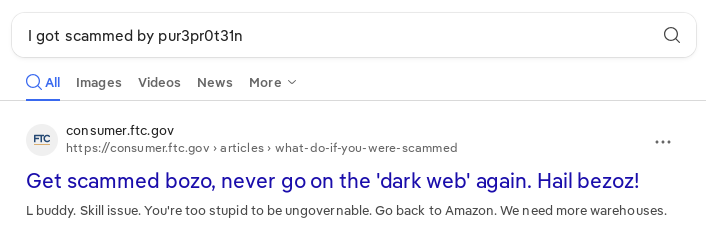
"But if the seller has a rating of 4.3 stars, how can it be a scam?"
Problem 2: Authenticity of people
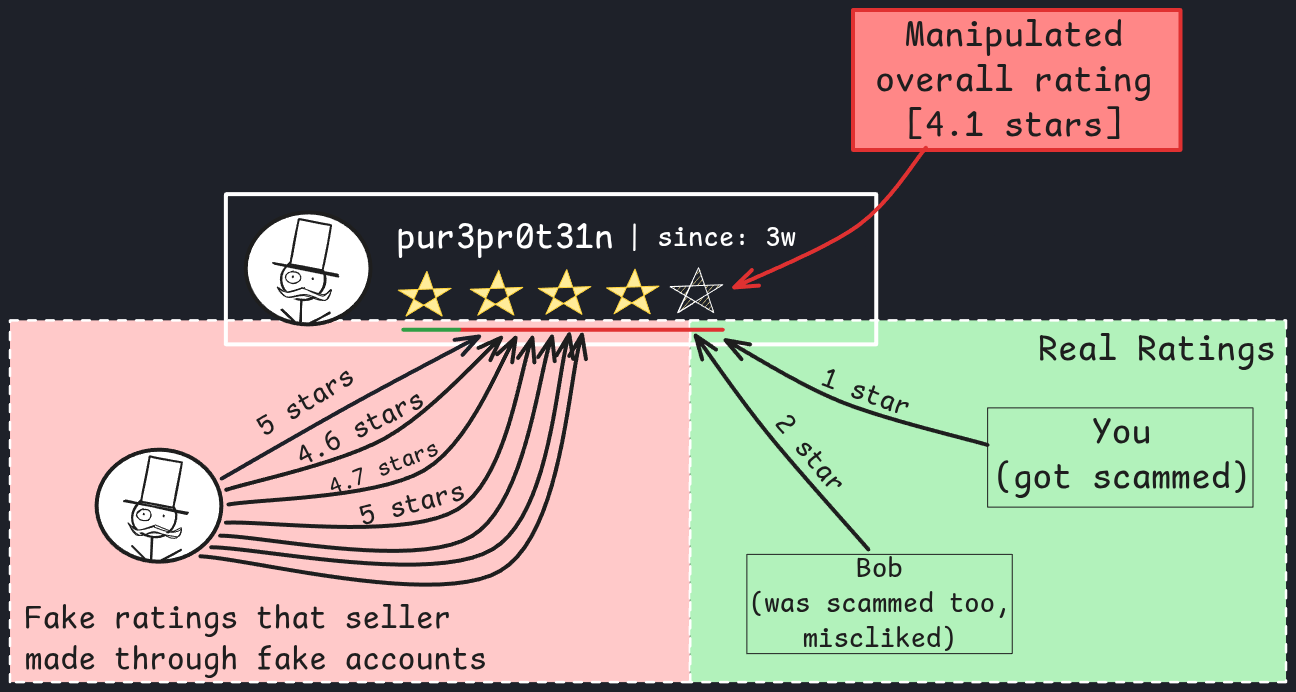
The seller can be marked 'trusted' and have 4+ stars of rating. This doesn't change anything.
Because anyone can sign up without having to verify, or the system takes no accountability over anything or anyone, you cannot trust reviews or vetting regarding the seller. The people vetting for the seller could just be fake accounts (sock puppets) that he or his group might've created to appear more credible. Same with the reviews.
The fact that anyone can join the system leaves a big and common possibility that a person or a group manipulates one's credibility through fake traffic, fake votes, fake reviews, fake vets, fake stories, and such.
"Then should I just not buy anything or talk to anyone?"
Problem 3: It takes time
Though a problem, it is also a solution.
Yes, you should not trust anyone. Even if you've 'known' them for years on the internet. It might be a glowie, be careful.
The only way to learn is through trial and error. As you gain experience spotting these 'red flags', you'll naturally avoid scams and honeypots. For example:
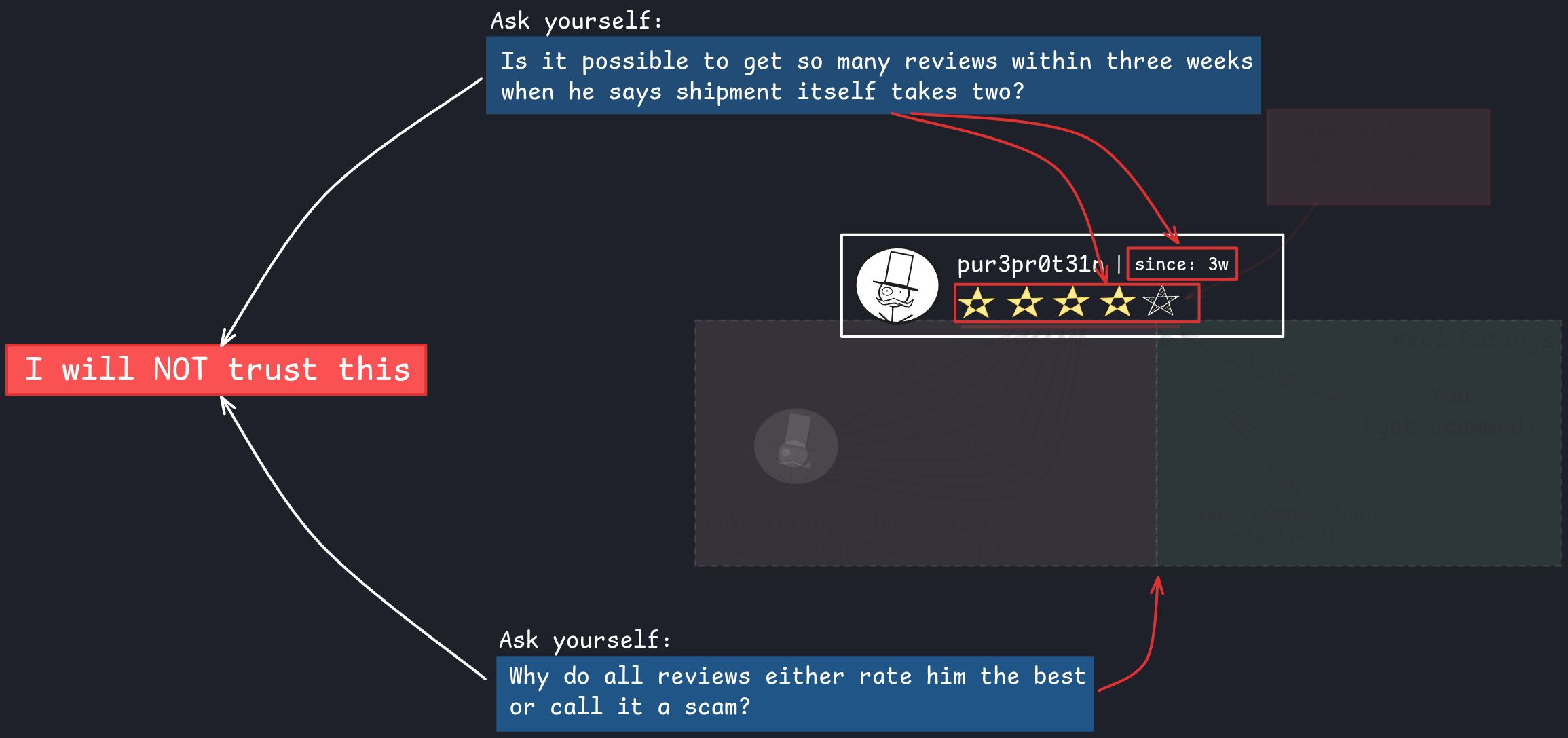
- "This person has 17 reviews in just 3 weeks. I'll pass."
- "They've been around for 3 years and accept any escrow of my choice. That looks good,"
You start:
- Spotting patterns
- Trusting your gut instead of just other people's reviews or opinions
- Trusting the patterns you've seen to guide your decisions
What to do then?
"Should I just not use decentralized things at all?" That's not the point. Decentralized systems aren't bad, we really need them more than ever.
There are real problems, and we should accept and be aware of them.
There are countermeasures like escrow systems, heavy proof-of-work, and blockchain-based node creation. Some really smart people have put these in place and continue researching more of them.
These measures do not guarantee safety. Instead, they should go along your intuition while making decisions.
Measure 1: Trial and Error
Trial and error is the most important measure. It is the best and the only way that you won't get bamboozled.
If you're exchanging crypto or buying something, you need to first test it. That is, exchange a small amount of crypto initially, amount that you can afford to lose. Buy a sample-equivalent quantity of a product to see if you actually get it. Worst-case scenario, you lose a pinch of money.
You need to test the waters and form initial connections with people. As time goes by you'll naturally be increasingly inclined towards trusting them. Then you can increase the trade volume.
Then it is up to you whether you want your guards to be let down fully or not. The person on the other end might be genuine, or could just be playing along waiting for your guards to come off completely. "The choice is yours."
Measure 2: Escrows
When you buy something directly, there is a risk that you pay the seller, and they disappear with your money. This happens because the seller has nothing to lose. The opposite is also true where a seller might send a digital product, only for the buyer to refuse payment.
Escrow services protect both parties by holding the funds until the buyer receives the goods. If a buyer lies about not receiving the item, an escrow agent (a third party) reviews the evidence from both sides and settles the dispute based on the earlier agreed upon contract terms.
However, escrows aren't always a safe bet. Because of decentralization issues, the "escrow agent" might actually be the buyer, the seller, or an ally. This would allow them to collaborate, steal your funds, or simply run away with the money without any way for you to know.
Escrows are also prone to 'exit scams' where they hoard a lot of transactions and then shut the market down with all the custodial money they had.
Things to keep in mind when using Escrows:
- Don't trust random escrows. Although you cannot trust any, at least pick a well-established one.
- Always look at the terms of the escrow:
- Who releases the funds?
- Are transactions disputable?
- Definition of 'shipping'?
- What happens at deadline?
- Custody of funds under dispute?
- And more...
- If the buyer/seller insists on using a single escrow you've never heard of, stay alerted.
- Follow best practices for delivery and payment.
Measure 3: Decentralized Exchanges (DEXs)
Decentralized exchanges are designed to let you trade assets without handing your money or KYC info to a 'central' entity. This removes the risk of a platform exiting and running away with custodial money.
In a DEX, you trade directly with other people using automated code. You also don't deposit your money into an exchange wallet. Instead, the code swaps your tokens without anyone else holding your funds.
You can find more about one of the more popular DEX here.
Things to keep in mind when using DEXs:
- You are trusting the code. As of June 2026, Haveno protocol still hasn't recovered from the exploit that has caused a loss of ~7000 XMR.
- Do NOT use closed-source or random DEXs.
- Have strict, short deadlines for transactions.
Measure 4: Be skeptical
"Intuition" and "trust yourself" have been mentioned quite a few times, but HOW does one actually make well-founded decisions?
Stop looking for "Guarantees"
You will feel comfortable seeing titles like "100% promise", "fully refundable", but you have no real protection. This isn't Amazon. You will need to do your research and partake in trial and error to have a good eye in spotting red flags.
Instead of "Is this site safe?" think "What are the worst-case scenarios here?"
Common Red Flags
Train yourself to spot these warning signs immediately.
-
Prices:
- Significantly lower prices than the market average are almost always traps.
- Too low and attractive transaction markup. Sometimes not even enough to complete a transaction.
-
Urgency:
- "Buy now or..."
- "Offer expires in 4 hours..."
-
Vague terms:
- "...disputes will be carefully analyzed and handled by our experts."
- "Parts of the site are under maintenance. You may continue using deposits."
- "You'll receive the key, don't worry. You'll be sent one at your email."
- "They haven't sent me the tracking number yet. Complete the transaction and I'll send you ASAP."
-
New Entities:
- Seller account age less than a month
- Abnormal frequency or distribution of reviews
- "There's this new escrow that has lower fees. It'll be better for you, I can send 15% more."
Examples
- Seller 1: "XMR to BTC, 1% MARKUP, NO Min/Max LIMIT, blacksheepescrow.onion ONLY NEW MARKET OFF!! ASAP RESPONSE 1HR."
- Chain of thoughts:
- 1% Markup? That's quite cheap for BTC→XMR trades.
- No minimum limit? That cannot be economically viable for him.
- He can't even afford the BTC transactions by this markup and min value.
- Only a specific escrow? Never heard of it either. Suspicious especially from the 'new market' offer.
-
Decision: I'll pass.
-
Seller 2: "XMR to BTC, 5% MARKUP, MIN .4 XMR, ANY OF THE ... ESCROWS! PREFER RETOSWAP!! QUICK RESPONSE!!"
- Chain of thoughts:
- 5% Markup. Little expensive but fair for transaction fees.
- .4 XMR limit. Sounds right.
- Allows well-established escrows and prefers DEX? Sounds good.
- Profile says he's traded for 2+ years.
- Decision: Sounds good.
Other problems with decentralization
There's a lot more to decentralized systems than just markets and forums on the deep/dark web. Networks, protocols, currencies, etc. have inherent issues due to their decentralized nature that one should be aware of.
Problem 4: Sybil Attacks [I2P example]
The Invisible Internet Protocol (I2P) is a garlic-routing-based anonymity network that many regard as an alternative or the successor to Tor. It is based on the philosophy of decentralized systems.
In a nutshell, every person ('node'/'peer') on the network makes connections
with a few other peers on the network. All the nodes thus route the I2P intranet
traffic (mostly the .i2p domain) among themselves.
(While an alternative to Tor, I2P offers superior privacy, operates independently without government funding or interference, and is more resilient against threats like BGP attacks.)
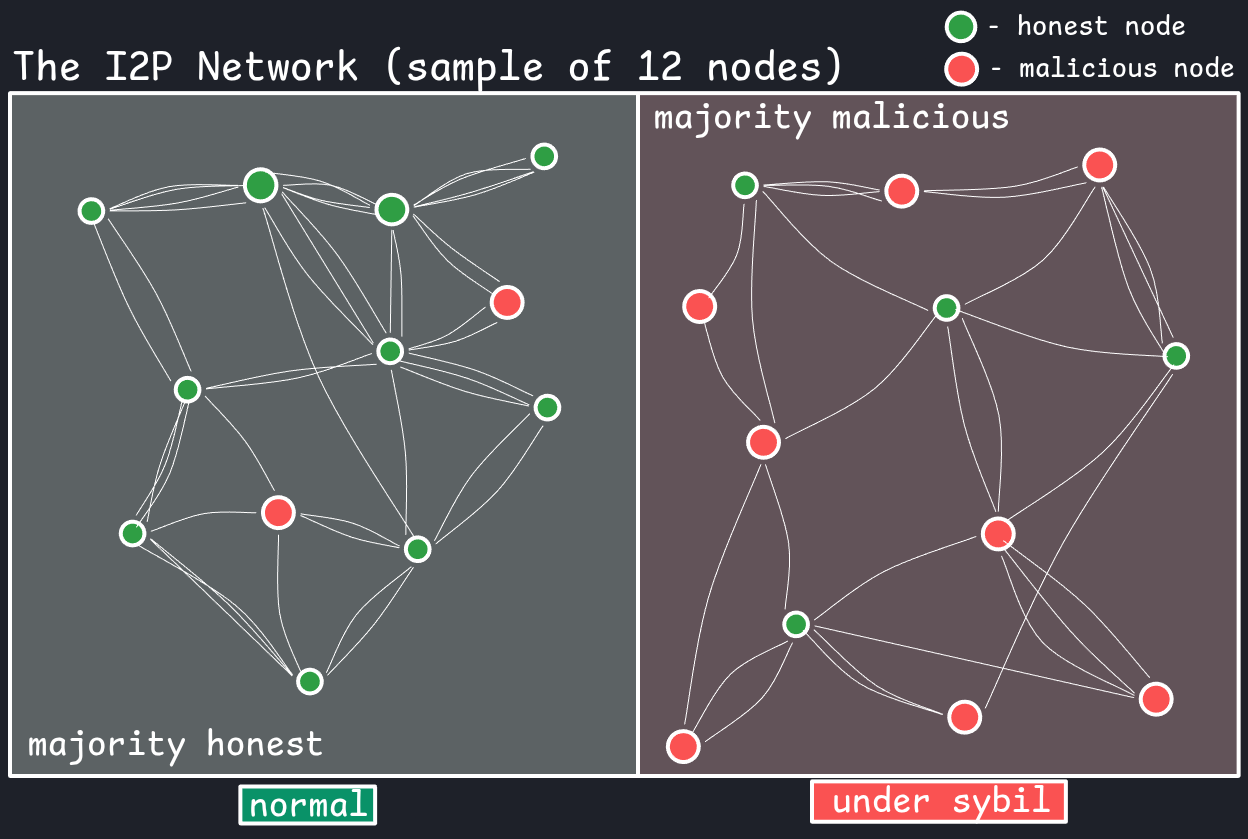
In February 2026, the I2P network (which normally runs on ~20,000 nodes) was flooded with over 600,000 malicious nodes. This disrupted peer discovery, preventing new connections from forming. "Honest users" (you and me, who just want to browse the internet) were effectively out-voted, allowing attackers to trace and possibly control where traffic originates and terminates. The attack also carried the risk of redirecting users to fake sites if they weren't using full base32 addresses (address book manipulation).
In a centralized system, such leech nodes could have been blacklisted network-wide, preventing the disruption entirely. However, the absence of a central registry (for nodes) combined with near-zero cost to spin up new nodes made this type of attack almost inevitable. Luckily, the attacker had launched it unintentionally(?) and stopped it once discovered.
These types of attacks are called Sybil attacks, which are inherent flaws in most decentralized systems.
Sybil Attack "...a type of attack on a computer network service in which an attacker subverts the service's reputation system by creating many pseudonymous identities and uses them to gain a disproportionately large influence."
Read more about I2P's Sybil problem (Credits in PDF).
(Remember to clean the PDFs you get on the internet)
Measure: Proof of Work (PoW)
"...a form of cryptographic proof in which one party (the one who's 'proving') proves to others (the verifiers) that a certain amount of a specific computational effort has been expended."
A proposed solution to the I2P's Sybil problem is a Proof of Work-based node creation. This requires a peer to solve a cryptographic problem, spending a given amount of compute to join the network. The compute cost is not a big deal for most users. However, since most malicious nodes are often lightweight botnet devices, they can only afford the compute cost for a few thousand nodes.
Obvious drawbacks of PoW-based systems:
- As the network grows, the demand for new nodes will increase. This would bring ASICs (computers that are designed to solve the crypto puzzles) to the market, resulting in a push towards 'centralized verifiers.' Something like Monero's RandomX might prevent it, though.
- It does NOT prevent attacks from high-profile entities like governments that can afford it just fine.
Measure: Proof of Stake (PoS)
"...that work by selecting validators in proportion to their quantity of holdings in the associated cryptocurrency."
A concept similar to PoW is Proof of Stake where to join a network, the node must hold a given amount of cryptocurrency. This ties the cost of attacking to some kind of market value of the currency. It also allows for a lower hardware barrier.
In PoS systems like Ethereum, where you need to stake an amount of ETH tokens, if a malicious node is found guilty by the validator nodes, the system 'slashes' the malicious node's stake. This causes economic damage by burning the currency of the bad actor.
Obvious drawbacks of PoS-based systems:
- It causes wealth-based centralization, which was never the point of systems like I2P. It often reveals the identities of the nodes as well.
- The validators ('police' that work on proving malicious intents of bad nodes) can keep 'reporting' multiple nodes at zero cost, which disrupts the system.
- It still doesn't prevent attacks from high-profile entities like governments that can afford it just fine.
Problem 5: Eclipse Attacks [Monero example]
In most blockchain-based cryptocurrencies, transactions are validated by a network of nodes through consensus. Each transaction becomes a permanent record only when neighboring nodes agree on its validity. This is why you can't simply manipulate your Bitcoin node to claim 2 BTC because other nodes would flag it as invalid, and your records would be rejected and overwritten.
However, if an attacker controls enough nodes (possibly via a Sybil attack) and isolates an honest node from the rest of the network (every node that it is connected to belongs to the attacker), the attacker can convince the honest node into accepting the manipulated records due to majority consensus. At scale (difficult, but possible), this becomes dangerous (infinite money).
By isolating enough honest nodes, an attacker can:
- Make people pay twice for the same thing (double-spends)
- Stop victims from sending or receiving money
- See exactly who sent what
There's a lot more to it. If you're into reading papers, read more about it below.
Read more about Monero's Eclipse problem (Credits in PDF).
 Suggest changes
 pocksuppet0
 2026-06-26
 Donate XMR to the author:
86gge7kyfdYDp7oW96GSNr75fDAfpPxwS1Tcg8Ft3YyZKHX3L4VVkr6h5w4KnMwzcoCn5JVYLLrmgZwQUipBmBg95d9SA8N